- Adopted by the NPPA Board of Directors in NPPA Statement of Principle
According to John, Long (1999) journalist have only one thing to the public and that is credibility. There is a relationship established between the author (news provider) and the recipient (news viewer) that is based on truth and integrity; any manipulation (that is recognizable) could damper, undermine or even break that relationship.
Yet there have been many manipulated photograph circulated in the media world as early as the 1860s, only a few decades after Niepce created the first photograph in 1814. Dartmouth (2009) One example is the portrait of U.S. President Abraham Lincoln published in 1860, it was actually a composite of Lincoln's head and the Southern politician John Calhoun's body.
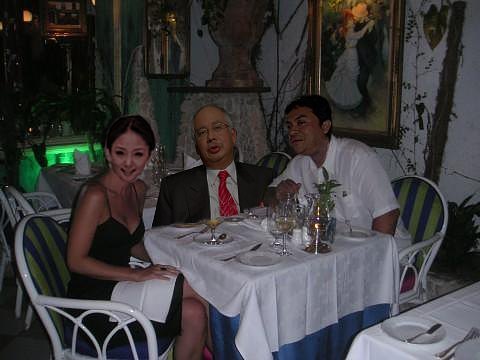
In Malaysia context, the picture of threesome dinner between Altantuya, Najib and Razak Baginda that circulated within while Malaysia is believed to have edited using photoshop. Though it is obviously fake, this photograph will somehow cause a political unrest. One of our Malaysian politician Tian Chua - has published this picture in his blog in order to propagates his political view.
Let's see another example from youtube on how Reuters manipulate the news photos.
Walsh (2006, p.29) opines that audience are inclining towards favouring text that has features of multimodality, the use of photos to increase a story’s effectiveness and quality are on a rise. Yes, we all agreed that with the integration of text and photos would spices up the quality of conveying effective message, but my question is 'How true is the photo you see?' When a news photo is being edited, it will never be a truth of a news event.
Besides that, (Lester 1999) also opines that by not maintaining credibility as a photographer will 'diminish journalistic impact and self-respect, and the importance of photography as communication'. It is essential to preserved a genuine photograph took from a news event to remain untouch because readers no longer rely solely on written text for comprehension; they absorb and process all that they see within a document to create meaning for themselves. (Harrison 2003)
An old saying that 'Picture Speaks A Thousand Words'. It is not created and being said for years for nothing, let's not ignore the originality of this famous quote as well as the originality of a photo.
References
Harrison, C, 2003, Volume 50, Number 1, 'Visual Social Semiotics: Understanding How Still Images Make Meaning, Technical Communication, pp 46- 60.
Walsh, M 2006, 'Textual shift: examining the reading process with print, visual and multimodal texts', in Australian Journal of Language and Literacy, vol. 29, no. 1, pp. 24 - 37.
Funnell, A 2007, 'The Power of the Photograph', The Media Report, access 2 June 2009,
<http://www.nataliafletcher.com/photo/sources.htm>
Lester, PM 1999, Picture Manipulations, access 2 June 2009,
<http://commfaculty.fullerton.edu/lester/writings/chapter6.html>

No comments:
Post a Comment